Upgrades4MGs
Get more from your B... Drivetrain & Chassis Upgrades
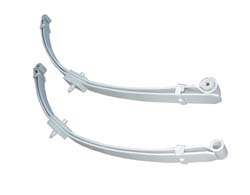
Parabolic Rear Springs
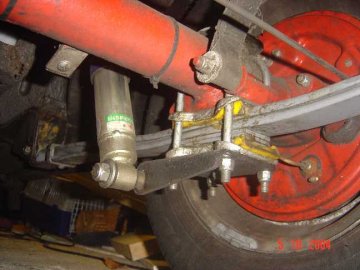
(Photo c/o Jim McGlynn's website- Parabolic rear springs)
The MGOC were one of the first to promote the use of parabolic springs and advertise accordingly on their website:
PARABOLIC
REAR SPRINGS FOR MGB-
When travelling over small bumps in the road, the force required to flex a
conventional multi-leaf spring is high, so it remains rigid and the bump shock
is transmitted through the car and felt by both driver and passenger. The
parabolic spring however has a parabolic taper rolled into it, thickest in the
centre and tapering evenly to the thinnest part at each end. The degree of
tapering is calculated proportionately to its length and load requirement. With
precise stress distribution throughout its length the spring flexes absorbing
lesser impacts whilst retaining its load bearing capability. Hence the ride
comfort is greatly improved also handling is enhanced with greater tyre to road
contact.
The springs come in various options from the MGOC for fitment to:
-
Chrome bumper Roadster - Banjo axle
-
Chrome bumper Roadster - Tube axle
-
Chrome bumper GT
-
Rubber bumper GT
-
Rubber bumper Roadster
-
Chrome bumper V8
-
Rubber bumper V8
Moss only list two options:
-
TMG40740 - Parabolic Rear Spring 100lbs - MGB GT & CB
-
TMG40741 - Parabolic Rear Spring 116lbs - MGB GT & RB
Both companies note the requirement to fit gas/oil telescopic dampers, the technical reasoning being that with far less interleaf friction (damping) of the multi-leaf springs, the increased damping effort required would lead to aeration of the damper fluid in the original lever arm units. Moss also state that the parabolics can be used in conjunction with the lowering blocks.
This seems to lead to much discussion on the forums, but it would appear that Doug Smith of MG Motorsport was experimenting with using the traditional lever arm dampers in combination with parabolics.
On this point of telescopic dampers, Phil Earl noted recently (April 2008) -:
"My opinion on these
having ridden in a few cars fitted with them
now is that the advice given to people who buy them from the MG Owners Club is
incorrect and that this information has filtered through to forums, etc, and
is also incorrect but well-meant. The standard rear springs are multi-leaf
and have a certain inherent amount of interleaf friction, meaning they are
quite stiff and require a lot of inertia for a reaction. The damping is a
little softer as the spring's ability to damp the shock is already accounted
for. Anybody who has ever fitted tube shocks to standard springs has
complained bitterly that they can only ever run them on their softest
settings because of this (which makes it rather pointless to spend more on
adjustable shocks!) Parabolics, on the other hand, are single leaf
springs;
i.e. no interleaf friction. To me, therefore it stands to reason that you
need to stiffen the rear dampers up to compensate. However, most people are
still "recommending" that the softest setting on tube dampers are used
only,
which to me means that most fitted to Bs are under-damped and the rear is far
too bouncy. The MG Owners Club say that parabolics can only be fitted with tube
shocks
(recommending oil dampers such as Bilsteins, Koni, etc over the gas filled gas
shocks) but someone - I think Doug Smith - was saying that he could fit them
with rear lever arms and that he believed the ride quality was better.
Note here that lever arms are traditionally considered to be stiffer in
their damping to tube shocks, so it would seem that stiffer damping for
parabolics is relevant."
Brynmor also has Koni's fitted with his Parabolics but says that despite the advice of the softest setting, he has them adjusted to a medium setting. "Parabolics are too springy with dampers on there softest setting. Even on medium the back of the car bounces slightly when I close the tail gate."
Michael Beswick sent me his thoughts on fitting the parabolics, reprinted below:
Parabolic
Springs.
Why
fit them? Age, both the driver and the old multi-leaf springs. Parabolics are
supposed to provide a more comfortable ride, and the original springs were on
the car when I got it, so their condition was unknown. I had noticed that the
most comfortable ride was with a passenger and a week’s luggage. The extra
weight (of the luggage!) helped dampen the ride.
I
considered fitting new standard springs but decided against them for two
reasons. One, there seems to be a question mark as to the resulting ride height,
and two, the price at about £49 a side leaves little profit for either
manufacturer or the distribution chain. i.e. they are probably made to a price.
Parabolics on the other hand at about £200 the kit allows it (hopefully) to be
manufactured to the necessary standard. I already have the necessary tube shock
absorbers.
MGOC
spares supplied it, though the kit only included rubber bushes. I ordered
polybushes having fitted them all round a few years ago. The kit also includes
the bolts that fasten the front eye of each spring to the car and the 4 u bolts
and nuts. (Currently MGOC offer to include the poly-bushes)
Fitting
was relatively simple- partly because I have access to a 2 post lift. If that is
not available, axle stands for the rear (chock the front!) and a trolley jack to
support the back axle. A second jack can be used to lift the spring up to bolt
it all together- see below). Just remember to use lubricant on all bushes&
shackle pins. I left the original polybushes in the chassis rails as I recall
fitting them last time was not easy. (A mixture of G cramps, brute force and
swearing). Jiggling the U bolts, plates and springs to tighten the bolts is easy
with a gear box jack when using the lift but can be done using a small trolley
jack if working on the floor. Doing one side at a time helps determine the angle
at which the shackle needs to be to bolt it all up.
Result:
Excellent! The ride is much improved. The harsh edge has gone, and while you
still know the suspension harks back to the 40’s, it is much less jarring. I
have not yet tried it on the track, where the handling is said to change. (A bit
more roll to start but then it tightens, and handles normally). However, as most
of my use is touring, I am more concerned about comfort!
Not
cheap but worthwhile.
Michael
Loosen up