Upgrades4MGs
Get more from your B... Engine Upgrades
Electronic ignition choices
First up is the popular 123 option.
From the web-page of the manufacturer:
"The ignition-system in a
classic car is often the source of many problems. After many years the
mechanical system is worn, and replacement of the points with an optical or
magnetical setup, does not make up for wear in the advance-mechanism, the shaft
and bearings etc.
Well, 123ignition is different. It comes in a housing, that exactly looks like
its mechanical counterpart on the outside, but that houses a lot of high-tech on
the inside.
A 123ignition keeps the looks under the bonnet 'original', but makes the engine
spin like a Japanese sewing-machine! Moreover : you don't have to sacrifice your
mechanical distributor.
The 123\GB-4-R-V replaces most
4 cyl. Lucas-distributors for engines in Great-British (hence 'GB') cars, where
the distributorshaft is turning in a CCW direction.
The unit offers 16 different advance-curves, that can be selected via a little
switch. This is a great feature for easy fine-tuning your engine!
It also offers :
- vacuum-advance
- automatic dwell
- spark balancing
- automatic power cut after 1 second
- gearshift retard
- etc.etc.
Note that there are didicated 123-ignitions for Mini, MGA & MGB."
There is now a USB version available allowing mapping from a laptop. If anyone has tried these, could you let us know how you got on with it, please? Email
 Picture
from their web-page
Picture
from their web-page
Whereas EDIS offers an infinite number of advance curves, it downsides are:
- Does not look original under the bonnet
- More involved installation and set-up
- Requires a laptop to set the timing
However, EDIS does allow the return to normal operation if failure of the EDIS system occurs, whereas with the 123, it would take a few more minutes to switch the distributors over assuming that you carry the old unit as back-up.
Those that have fitted it report better starting and smoother running, perhaps something that would happen with a new distributor in any case, but the benefits normally associated with electronic ignition would include a better spark, but more importantly, minimal maintenance of the ignition system.
For those considering fitting this, this page includes a PDF file covering installation.
The photograph below is from Nicholas Argyrou of the MGOC:
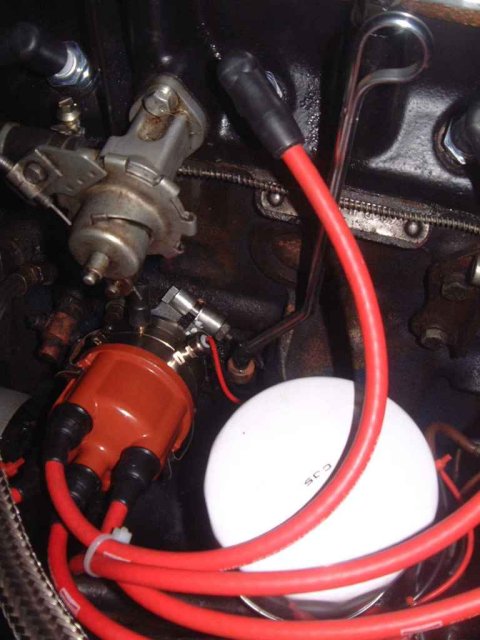
The Ford Electronic Distributorless Ignition System. It offers the ability to uniquely map an advance curve to precisely match your engine's needs, rather than relying on a mechanical advance curve constrained by weights, spring tension, and inlet vacuum, and unlike the mechanical system, EDIS is not subject to wear. Once programmed, it remains set.
Is EDIS right for me?
- Do not attempt this fit unless you are handy with the tools, it requires a few fabricated brackets, and skill with the soldering iron.
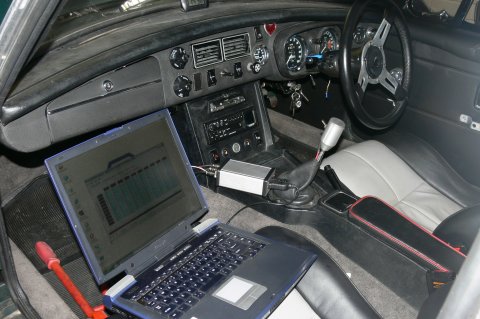
- If you do not have a lap-top or at least a PC near the car, then go 123, especially if you are just not computer literate as it takes a little effort to install the MegaJolt software.
- If originality is important, then forget it, it doesn't fit under the bonnet as inconspicuously as a 123 or other electronic kit inside the distributor - the EDIS will stick out like a sore thumb.
- Fitting a new distributor properly set-up for your advance curve needs will probably bring equal improvement in starting and engine tick-over and smoothness - that is, until the points gap starts closing up again as the heel wears, but for similar money a new distributor is the alternative for the reasons given in points 1-3 above.
That said, then yes, it is a worthwhile upgrade:
- It uses production car parts from a Ford so is generally reliable.
- If a fault occurs with the EDIS, assuming the old distributor and coil are still in place, these can be reconnected within a minute (I timed it out of curiosity) so no hanging around at the roadside.
- If your engine is tuned beyond the factory design, then an advance curve can be mapped to suit it exactly, and easily re-mapped should you make any other modifications to the engine at a later date.
- Once set it won't go off tune - so it minimises loss of performance between services, and extends the plug life.
- On an electronic level a fatter spark can be achieved, and along with the improved running, there's a gain in fuel economy - I have had as much as 35mpg (12.5km/L or 8.5L/100km) on a motorway run at 70mph (110kph) or a little over (I won't say how much over!).
- I have also seen an increase in max rpm from 5500 to well over 6000rpm (my engine is balanced). This has allowed me to exploit the full benefit of my engine set-up, and I find that when using the full revs, and changing up to 3rd I don't have the lag owing to the big gap in the ratios.
As said above, a new distributor could probably bring you most of these benefits until it wears out again, whereas the EDIS is solid state so maintains optimum performance. Is it for everyone? No, not at all! It works for me for my needs, but others will beg to differ based on their needs or opinions.
How hard is it to create the map that suits the car? It seems this is quite a lengthy process that also requires some serious understanding of the influence of the parameters?
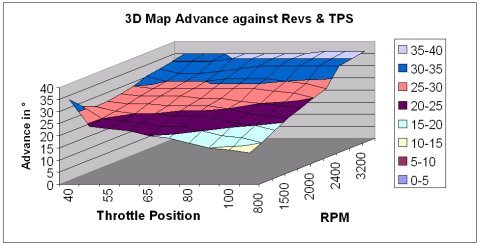
The MegaJolt software, once installed, is fairly easy to play with, being a 3
dimensional grid with input for advance against revs and TPS (or rather MAP -
but we are not using MAP, rather TPS). We used TPS because of the pulsating
pressure from the manifold on the B, although I am told that a basic petrol
filter would help dampen these pulses but I have not tried that as yet.
The first problem is installation of the software as so few laptops now have an
RS233 port so you need a USB adaptor, and there are two types, the later type 2
works fine, but it needs drivers installing.
Once that is done then you are clear to start playing. Matt supplies a basic map
which is what I am still using with a few tweaks on idle but by listening to tick over
we can play easily enough with the advance at idle (the top left hand
corner of the grid as per the diagram on here
- which is an Excel chart
built on the CSV file exported from the MegaJolt s/ware). This is the same as
rotating the dizzy.
Now the cheaper option would be to take a passenger and laptop and do the same
basic set up as you would with a distributor - that is try some acceleration
runs and keep advancing the map until you find the pinking then back off.
Obviously this is easier on a rolling road, but if you allow for the basic 3-D
curve, then just keep pushing up all the figures accordingly.
Where it will get more tricky is changing the curve at various points, but here
you are into the realms of seeking expert advice - as you would in any case with
setting up a distributor correctly; where years of experience will tell the
tuner exactly where in the rev range and at what throttle opening the advance
would benefit from tweaking. However, this is a matter of typing in new numbers
as opposed to filing bob-weights and changing spring tension.
What gains can I expect?
This is the first run on normal set-up with a new distributor.

The second run with EDIS having taken the opportunity to tweak the advance curve across the rev range.
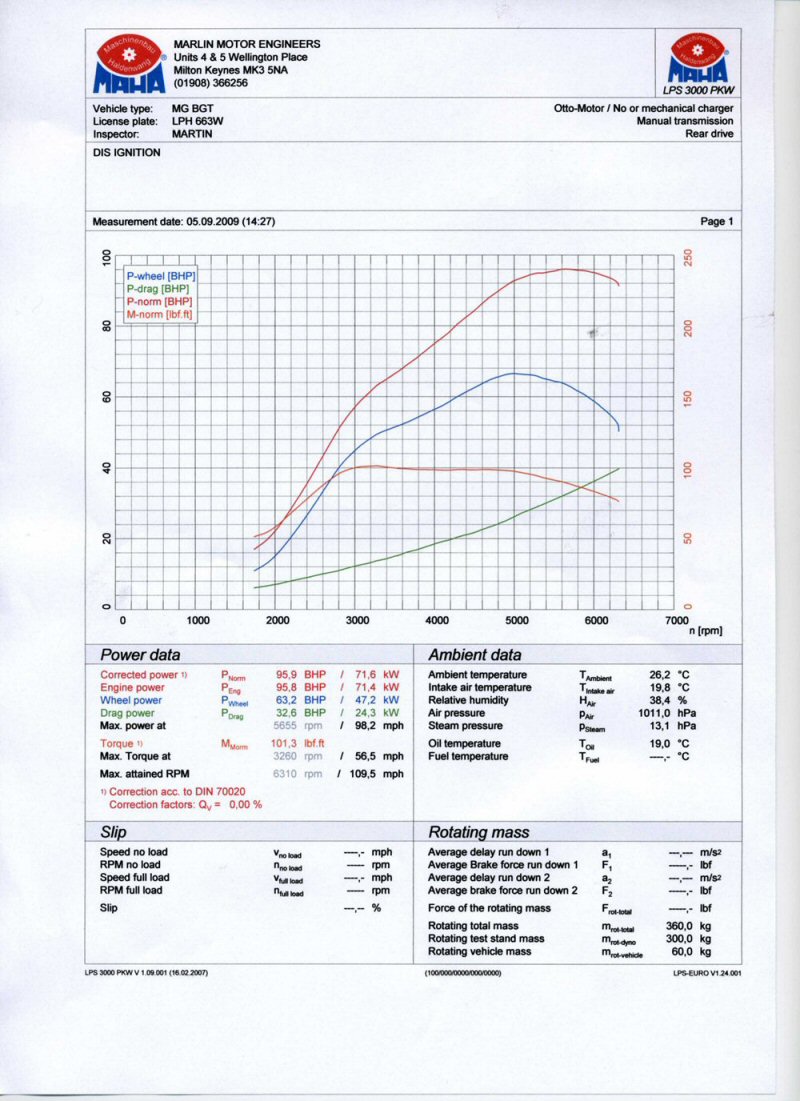
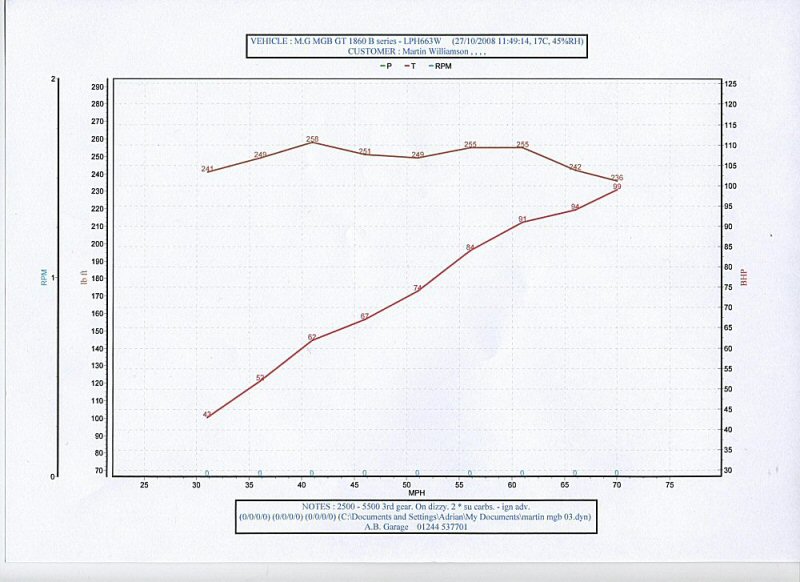
Comparatively speaking, the difference is small in terms of engine power but the wheel power measured is up by 8bhp. This doesn't tell the whole story as the car is more driveable. The same can be said for the 123. A fellow MGOC member found the torque was falling off around the 3000rpm point then picking up again. This was sorted by simply trying the next setting on the 123 switch resulting in a flatter torque curve.
In case you thought the power numbers above looked a bit weak, I did, too, because here is the same car one year earlier with a normal distributor set-up on a local rolling road in Cheshire producing 99bhp at the rear wheels. It really boils down to the before and after measurements rather than absolute values.
EDIS or 123
Why electronic ignition? It's far more accurate than the old points system, and never needs resetting is the short answer. Other benefits include a fatter spark, thus better burn and performance, as well as cleaning up the power meaning the spark plugs last longer. Apart from that, many distributors will be worn and hence the timing will be difficult to maintain accurately. Replacing the distributor with a new one will often see benefits in normal running, but if you are wanting to optimise engine modifications then it is essential to consider upgrading the distributor and coil.
So as a performance and reliability benefit, electronic ignition systems make sense.
On this page: