Upgrades4MGs
Get more from your B... Engine Upgrades
Fitting the T Series
Roger Parker of the MGOC is the pioneer here having done this conversion using an M16 engine in the late 1980s. The photo below is from the August 1991 issue of MG Enthusiast which detailed the work undertaken by Roger in conjunction with John Hill's of Redditch, using the 2.0L M16 engine, as used at that time in many Rover 820 cars with 140bhp at 6000rpm, with a useful 131lbft at 4500rpm. The engine is mounted to a Rover 77mm 5 speed gearbox.
From Roger's article in Enjoying MG:
"The beauty of the M16 (and T16) is that the block mountings are exactly the same as the 8-valve engine so any item that attaches to the outside of the 8-valve engine can, in principle, also fit the 16 valve versions. So the creation of an in line 16 valve engine simply follows the use of the same post 1986 Sherpa parts as previously listed.

Fitting follows the same rules as the previous O2 and 5-speed fit, except that now you have a much larger head assembly and so you need more room. The top edge of the cam cover in particular ends up so close to the bonnet that the reinforcing brace halfway along the underside of the bonnet gets in the way and has to be removed or moved!

I used the M16 in 1991 and again in 1996 for two MGB conversions. Bolting to an
LT77 (or R380) involves nothing more than post 1986 Sherpa parts and the same
source is needed for sump, oil pick up, end plate flywheel crang sensor, starter
and a few other odds and ends. This also applies exactly for the T16, although
now the grouped ancillaries want to occupy the space where the left chassis rail
is in an MGB. M16 provides a simple solution and in fact one of the T16 Turbo
FWD cars I helped build went this route as it had no PAS and was previously
fitted with an M16 so there was a suitable ancillary layout available.

On my later M16 MGB conversion because the standard cast exhaust of M or T
series wants to go through the same left chassis rail, I used a T16 turbo
exhaust manifold without the turbo to solve the space problem with a home made
downpipe that had to be curved sharply around the starter which sits on the left
side of the engine in the Sherpa. (this was a budget constrained job) If anyone
wanted to bolt a Turbo onto the M or T engine then the standard exhaust manifold
doesn't help as not on is the starter an issue, although could be re-engineered
to the other side, but the turbo itself would need to have a major section of
the left chassis rail removed to allow it to fit.

Best to go with a one off manifold that keeps the turbo high in the engine bay
like the Sierra/Escort Cosworth engines and visible in the Cosworth engined MGB.
Mind you a genuine 240 to 250bhp is available from these engines with the
tweaked range of setting available within the original MEMS control before a replacement
ECU is needed which is very much easier now than 10 years ago when I
was deeply into this. Over 500bhp can be extracted from these engines, with
serious mods of course and then it isn't the engine that is a problem, it just
eats gearboxes!
I only know of two in line production applications in any volume and then these
are small, the Discovery MPi which used a rather heavy alloy end plate that is
less suitable for an MGB application and the Morgan Plus 4 which used M and T
series engines and followed the Sherpa parts bin route.
Fitting O,M or T into an MGB uses simply made mountings that hang the engine off
four of the 6 tapped bosses for engine mounting provided at the front end of
either side of the blocks, A transplanter's dream for convenience from an OE
manufacturer."
The one plus with this conversion is the option to go to the T series with Turbo (as used in the Rover 220 Tomcat coupe, and 620Ti, and 820 Vitesse) - Nice choice for nearly 200bhp or more!
There are also details on overcoming some of the common issues such as oil leaks and weak head gasket and dowels.
One such Turbo that I know of is that belonging to Oliver Stephenson:
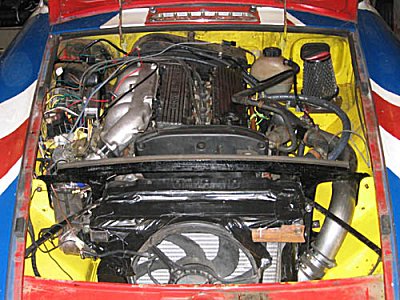
In reply to an email I sent, Oliver provided the following:
"Sherpa parts weren't of any help to me, my car is a Mk1 and this makes things a bit more complicated. I have a 4-sync O/D MGB 'box, but as documented on the very popular gearbox swap pages on my website, it is modified to fit a 3-synchro back-plate / starter / flywheel. I retained this set-up with the T16 as I didn't want to chop the tunnel, and there are no back-plates that bolt to both the T16 and the 3-sync MGB 'box. My back-plate is homebrew, and this has to be centred on the engine and gearbox to within a few thou! The 4-sync 'box is plenty strong enough, also I have gear-variable boost capability so I don't unleash the whole 220 lbs/fit in first or second.
O2 sumps don't clear the cross-member, again I made one that fitted the car. The oil pump doesn't clear the cross-member either! Much more homebrew here. Alternator modified and moved, totally custom water pump made, lost the PAS pump, everything apart from the rover block and head basically.
Why use the basic EDIS when the rover MEMS system is so good? There's a wasted spark option available. Ain't no disi in my heater! (Note - I mentioned using EDIS to overcome the issue of the distributor fouling the heater box)
The upshot of all this hard work (has taken me ~3.5 years to get the car to be practical and usable) is that it goes like the proverbial! Most modern performance cars have no noticeable performance advantage and there's still more to come from my engine even before I start putting bigger blowers etc. on it."
Further Notes from Roger Parker on what is needed for a T Series into an MGB:
"Look for the Post '86 Sherpa
sump, oil pick up, engine end plate and crank spigot bush and bearing as these
will be needed to convert the FWD O, M and T series blocks to RWD. (Note
- I have purchased a stock of crank spigot bushes.)
The M series flywheel is the same as the O and T series in terms of being for
the FWD saloon and twice the weight and thickness meaning the clutch won't fit
and it redrilled the clutch release will be in the wrong place and have the
wrong length. O2 Sherpa uses a thin flywheel to suit the application and a 36 -
2 early pre 1995 Rover reluctor pattern in the back of the flywheel.
Post 1995 flywheel operate on the 36 - 4 (tooth every 10 degrees with four
missing) and the standard ECUs have to match the same model year of reluctor.
Emerald and other aftermarket ECUs are configurable to different reluctor
patterns, although I have to point you to Emerlad as the K3 with three map
settings that can be adjusted on the fly from a dash switch works brilliantly
with the T16 Turbo engine as demo'd on a Maestro I have known since it's
inception many years ago.
Alternative to the Sherpa is to look for the rare Discovery MPi which is a T16
non turbo engine mated to the LT77 via a different bell housing, but here the
gearbox connects directly to the LT230 transfer box. Front end bits can be
bolted to any LT77 or R380 though."
T Series Power
